


70 MHz – 6 GHz | 56 MHz Bandwidth | USB 3.0 Bus-Powered | Full Duplex SISO
The HM B210 is a fully integrated, single-board Software Defined Radio platform offering continuous frequency coverage from 70 MHz to 6 GHz, up to 56 MHz of real-time bandwidth, and plug-and-play USB 3.0 connectivity — no external power supply required.
USRP B210 Software-Defined Radio (SDR) Platform
70 MHz–6 GHz | Up to 56 MHz Bandwidth | 2 TX and 2 RX | AD9361 | USB 3.0
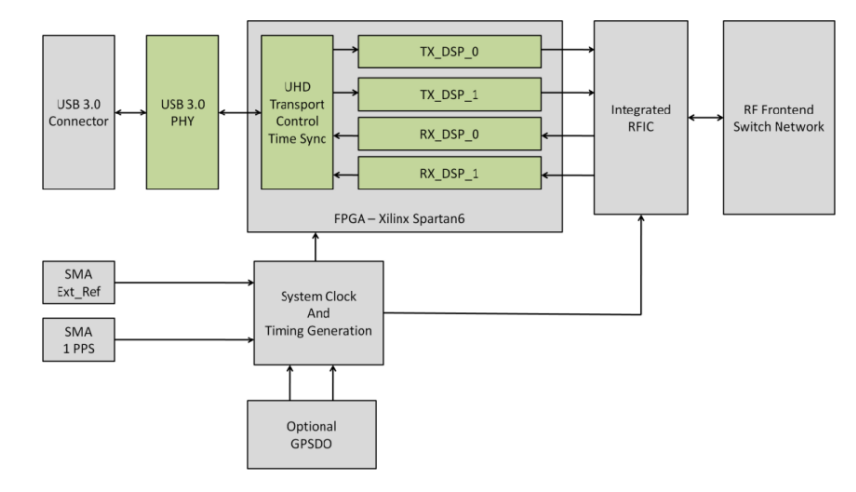
The HM B210 is a compact dual-channel software-defined radio for wireless communication research, RF signal development, university laboratories and system prototyping. It integrates an AD9361 direct-conversion RF transceiver, a Xilinx Spartan-6 XC6SLX150 FPGA and SuperSpeed USB 3.0 connectivity on a single board.
With continuous frequency coverage from 70 MHz to 6 GHz, up to 56 MHz instantaneous bandwidth and coherent 2×2 MIMO operation, it can support signal generation, reception and analysis across many wireless applications. Customers can submit their software environment, frequency range, bandwidth and channel requirements to Highmesh for compatibility review.
Request HM B210 Technical Information | View HM USRP B Series
The integrated RF front end covers commonly used VHF, UHF and microwave communication bands without requiring a separate RF daughterboard. It can be used for cellular, GNSS, Wi-Fi, ISM, IoT, broadcast and custom waveform research.
The HM B210 provides two transmit and two receive channels. Its coherent 2×2 MIMO architecture supports simultaneous dual-channel transmission and reception, spatial diversity, channel correlation measurement and multi-antenna experiments.
The AD9361 supports up to 56 MHz instantaneous bandwidth. Actual continuous streaming performance depends on active channels, sample rate, USB controller, host computer, storage speed and software workload.
The SDR connects to a host computer through SuperSpeed USB 3.0, making it suitable for laboratories, portable test systems, teaching platforms and engineering development.
| Parameter | Specification |
|---|---|
| Product Model | HM B210 |
| Product Type | Dual-channel software-defined radio |
| Frequency Range | 70 MHz–6 GHz |
| Instantaneous Bandwidth | Up to 56 MHz |
| RF Transceiver | Analog Devices AD9361 |
| RF Architecture | Direct conversion |
| Transmit / Receive Channels | 2 TX / 2 RX |
| MIMO Capability | Coherent 2×2 MIMO within one device |
| Duplex Operation | Half duplex or full duplex |
| FPGA | Xilinx Spartan-6 XC6SLX150 |
| Host Interface | SuperSpeed USB 3.0 Type-B |
| ADC | 12 bit, up to 61.44 MS/s |
| DAC | 12 bit, up to 61.44 MS/s |
| RF Connectors | SMA |
| External Timing Inputs | 10 MHz reference and 1 PPS |
| Dimensions | Approximately 97 × 155 × 15 mm |
| Weight | Approximately 350 g |
| Development Driver | UHD-based workflow |
| Development APIs | C++ and Python |
| Common SDR Environment | GNU Radio |
The HM B210 is designed for programmable SDR development. UHD can provide the communication layer between the host computer and SDR hardware, while applications may be developed using GNU Radio, C++ or Python.
Other platforms may require specific drivers or integration work. For compatibility review, provide:
Host operating system and software versions
Required frequency, bandwidth and sample rate
Number of active TX and RX channels
Streaming duration and recording requirements
External clock or synchronization requirements
Intended application
The HM B210 can support teaching experiments involving modulation, demodulation, spectrum analysis, synchronization, channel measurement, MIMO concepts and wireless protocol development.
Researchers can use the platform for physical-layer algorithms, OFDM, cognitive radio, channel estimation, wireless sensing, dual-channel acquisition, spatial diversity and 2×2 MIMO experiments.
With suitable antennas, filters and software, the HM B210 can be integrated into systems for spectrum observation, interference analysis, RF environment measurement, signal collection and laboratory recording.
The operating range covers commonly used cellular, GNSS, Wi-Fi, IoT and ISM bands. Suitability for a specific radio environment depends on software version, bandwidth, host capability and timing requirements.
The HM B210 supports external 10 MHz and 1 PPS reference inputs, allowing devices to share a common frequency and time reference when connected to suitable timing equipment.
Shared timing does not automatically guarantee phase coherence across independent USB devices. Buyers planning multi-device systems should specify the required channel count, sample rate, timing accuracy and calibration method.
| Selection Factor | HM B200 | HM B210 |
|---|---|---|
| Transmit Channels | 1 | 2 |
| Receive Channels | 1 | 2 |
| MIMO | Single-channel operation | Integrated 2×2 MIMO |
| RF Transceiver | AD9364 | AD9361 |
| Best Suited To | Basic SDR experiments | Dual-channel and MIMO research |
| Host Interface | USB 3.0 | USB 3.0 |
Choose the HM B200 for single-channel projects. Choose the HM B210 when the application requires two receive channels, two transmit channels, coherent 2×2 operation or dual-channel signal comparison.
Compare HM USRP B Series Models
System planning should consider USB 3.0 bandwidth, CPU performance, memory, storage write speed, operating system, active channel count and real-time processing requirements.
Depending on the application, the system may also require:
Frequency-matched antennas
50-ohm RF cables and terminations
Attenuators, filters or low-noise amplifiers
External timing equipment
Protective enclosure and USB 3.0 cable
High-speed host storage
To receive a suitable configuration and quotation, provide:
Required quantity and destination country
Application and project description
Target frequency range and bandwidth
Required channel configuration
Software and operating system
Timing, accessory and delivery requirements
Price, evaluation order availability, lead time, warranty, software compatibility and supplied accessories are confirmed according to the requested configuration and current quotation.
Highmesh develops and supplies software-defined radio platforms for teaching, wireless research and engineering development. Customers can contact the team for product selection, compatibility review, SDR configuration, accessory selection and project-based integration support.
The HM B210 is a Highmesh dual-channel software-defined radio covering 70 MHz to 6 GHz. It combines an AD9361 RF transceiver, Spartan-6 XC6SLX150 FPGA and USB 3.0 interface.
Yes. It provides two transmit and two receive channels for coherent 2×2 MIMO operation within one device.
The RF transceiver supports up to 56 MHz. Actual streaming performance depends on channel count, host computer, USB controller, sample format and software workload.
It is designed for UHD-based SDR development and can be used with GNU Radio through an appropriate software environment. Exact versions should be reviewed before deployment.
Multiple units can share external timing references, but common timing alone does not guarantee phase coherence across independent USB devices.
No. The HM B210 is supplied under the Highmesh brand. Buyers requiring another brand should confirm the manufacturer and product documentation before ordering.
Please provide quantity, destination, application, frequency, bandwidth, channel requirements, software environment, timing needs and required accessories.
Tell Highmesh how you plan to use the HM B210, including the required frequency, bandwidth, channel configuration, software environment and quantity. The team can review your requirements and provide available technical information, configuration recommendations and quotation details.
Contact Highmesh About HM B210


